Today we are going to learn about an art so old that the first example of it is the Dancing Girl from Mohenjo-Daro! Yes, we are going to take a journey to Bastar, to learn more about Bastar Dhokra! The image credit goes to Sumita Roy Dutta and is used under creative commons.
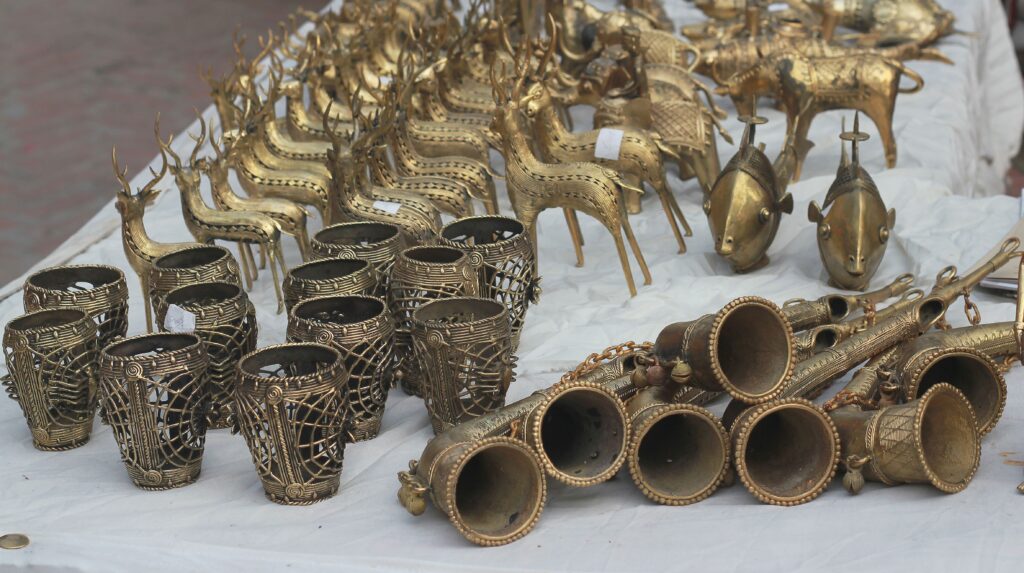
If you have been to Raipur, the capital of Chhattisgarh or if you are into crafts, you would have seen the Baster Dhokra objects even if you do not know it by its name! Baster Dhokra is an art form and as the name suggests it originates from the tribal traditions of Bastar. These brass and bronze alloy metal statues and objects attract instant attention due to their unique shapes and intricate carvings! It is like creating poetry with metal! The Nandis, ornate lamps, tortoise figures etc. catch our eye even if we get a glimpse of them at Raipur airport shops.
As mentioned earlier, Baster Dhokra traces its origin back to the famous statue of the dancing girl of Mohenjo-Daro, an art with about 4500 years of history behind it. And it is still thriving in Bastar. My interest was piqued and I started investigating. The more I learnt the more fascinated I became! I have not been to Kondagaon, one of the biggest tribal hubs of Bastar Dkokra, but I would do so at the next possible opportunity and bring back a few beautiful pieces for my home.
Bastar Dhokra art has Bharat Geographical Indication (GI) tag granted by the Government of India in recognition of the unique Dhokra art form of the Bastar region in Chhattisgarh. It is celebrated for using the traditional lost-wax-process (cire perdue) without any mechanization.
What has my absolute admiration is that the entire process uses local materials, scrape metal and it is so ecofriendly. To make a Bastar Dhokra object say a tortoise, the artisans, make a rough structure of the intended piece of the tortoise by hand. They use a mixture of red soil, rice husk and river clay that is kneaded together. Once the dough has formed into the desired shape the structure is left to dry in the hot sun
The next part of the process is totally amazing. They use bee’s wax, resin and nut oil and heat it on pot over wood fire in a brick kiln. Then they let it cool and collect the consolidated wax. It is later pressed through a mold using a wooden lever. Long threads of bee’s wax come out of this simple instrument. You can watch the attached video to get a better idea of the process.
When the clay mold which was left out in sun is dry after a few days, bean leaves are rubbed on it to give it stickiness. The long bee’s wax threads are then pasted on the clay mold creating intricate designs on the structure. Watching the patterns even in a video left me spellbound! The artisans create such magnificent weavings from the threads that it almost seems like magic. Once the design is finished, they apply an outer mold of fine mud mixed with cow dung which captures every detail of the bee’s wax design onto it. Then another heavy clay mix with rice is applied on top. Holes are made in the structure, and a funnel is attached because it is used in the next step!
Simultaneously the artisans fire a kiln where they melt nonferrous metals which usually contain scrapes of brass and copper.
The mud mold is also thrown into fire. Due to heat the bee’s wax pours out of the holes made and gets destroyed. This leaves a hollow between the two layers with the intricate design print in between!! It is worth noting again that the entire process uses sustainable local products like mud, leaves, rice husk and other such biodegradable products!
Once the mold is out of kiln, molten nonferrous metal is poured inside it through the attached funnel. This is left to cool down. The mud structure is broken once cool and the metal is polished, using simple tools. The finished product is simply outstanding! In this way each mold is used only once and hence each piece is unique.
The motifs of Bastar Dhokra depict the Devis and Devtas of the region, daily life of the tribals and their strong connection with nature. The region’s philosophy is mostly nature base. Local deities like Bhairav and Danteshwari Devi are prominent but so are the elephant, the horse, Nandi, tortoise, trees and other such motifs.
The art is practiced by the tribes of the region particularly the Gadhwas. Kondagaon is one prominent place where Bastar Dhokra is made. Jagdalpur is the nearest big city to Kondagaon. It is about 230 Kilometers from the capital, Raipur.
If Kondagaon near Jagdalpur in Chhattisgarh has not been on your bucket list, mark it now! It has moved very high on mine too!
PS. Looking for shopping ideas for your next trip? Click here and shop through my Amazon affiliate link.